Read online Coagulation and Flocculation, Second Edition: 126 (Surfactant Science) - Bohuslav Dobias file in ePub
Related searches:
Coagulation and Flocculation in Water and - IWA Publishing
Coagulation and Flocculation, Second Edition: 126 (Surfactant Science)
Coagulation and Flocculation - 2nd Edition - Bohuslav Dobias
Coagulation and Flocculation in Water and - ResearchGate
COAGULATION AND FLOCCULATION
Water supply system - Coagulation and flocculation Britannica
Coagulation and Flocculation (Surfactant Science): Dobias
Coagulation and Flocculation in Water and - Amazon.com
1.4: Coagulation and Flocculation - Workforce LibreTexts
COAGULATION and FLOCCULATION - IRC Wash
Coagulation and Flocculation (SURFACTANT SCIENCE SERIES
COAGULATION AND FLOCCULATION, Second Edition
Lecture 5: Coagulation and Flocculation
Difference Between Coagulation and Flocculation Coagulation
Lesson 4: Coagulation and Flocculation
COAGULATION AND FLOCCULATION - MRWA
Get the Waste Water Treatment by Coagulation and Flocculation
Blood clotting coagulation - Diagnosis and Treatment
Coagulation and Flocculation & Process Fundamentals
Flocculants and Coagulants ChemTreat, Inc.
Coagulation and flocculation: Part II—Orthokinetic
Coagulation and Flocculation in Water and Wastewater
Between coagulation and flocculation, which one is reversible
L 17 coagulation and flocculation - SlideShare
COAGULATION, FLOCCULATION AND CLARIFICATION OF - Hach
Progress, challenges, and opportunities in enhancing NOM
About Coagulation and Flocculation – Water Specialists
Coagulation, Flocculation, and Denaturation: A Century of Re
(PDF) Lecture 5: Coagulation and Flocculation Prepared by
Coagulation and Flocculation of Flexographic Ink Washwaters by
Operational Control of Coagulation and Filtration Processes, Third
Prospects and Challenges of Using Coagulation-Flocculation
COAGULATION AND FLOCCULATION TREATMENT OF - CORE
envis.org - Coagulation and Flocculation
Coagulation and flocculation. - CAB Direct
Efficiency of Coagulation and Flocculation Process Combined
When two colloidal particles approach each other, they are subjected to two major types of force.
At this stage, the flocculation treatment mixers mix another chemical, a polymer, is added which helps keep the macroflocs together.
Oct 9, 2015 coagulation and flocculation usage in wastewater treatment amounts of ions in the two layers and thereby affect the stability of the particles.
Is a water treatment process that causes very small coagulation suspended particles to attract to one another and form larger particles. Consist of adding a floc-forming chemical reagent to a water to enmesh (catch) or combine with non-settleable colloidal solids and slow-settling suspended solids to produce a rapid-settling floc. Is a water treatment process following coagulation, flocculation.
What is coagulation and flocculation? flocculation and coagulation treatment chemicals are used in effluent wastewater water treatment processes for solids removal, water clarification, lime softening, sludge thickening, and solids dewatering.
coagulation and flocculationconsist of adding a floc- forming chemical reagent to a water to enmesh or combine with nonsettleable colloidal solids and slow- settling suspended solids to produce a rapid-settling floc.
Oct 16, 2013 content part-i •coagulation, types of coagulant, part-ii •dosing, rapid mixing, flocculation-design parameters.
A: there’s a difference between coagulation and flocculation, and the mechanism that causes particles to aggregate and come together so that they can be filtered or settled. Coagulation is the neutralization of the electronic charge on suspended particles. Particles in water, such as clay, usually have a negative charge.
Thus, the terms ‘coagulation’ and ‘flocculation’ are considered to be the same for the purposes of this paper and the term ‘coagulation’ is utilized herein. ) not only does it impact the form and surface charge of coagulants utilized, but also the self-same parameters for the impurities that are to be removed.
Coagulation and flocculation in water and wastewater treatment 2nd edition treatment provides a comprehensive account of coagulation and flocculation.
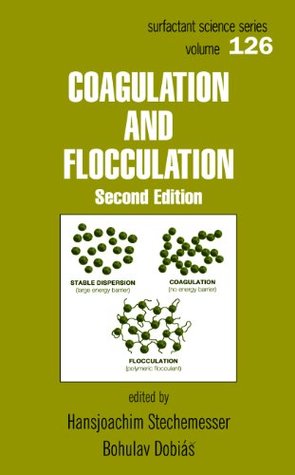
The second edition of coagulation and flocculation effectively captures both the theoretical and application aspects of the latest advances in the evolving field of solid dispersions, suspensions, and mixtures.
Mar 19, 2021 one of the most important steps in the water treatment process is the removal of suspended solids.
Of coagulation and flocculation are employed to separate suspended solids “ flocculation” is used to describe both; they are, in fact, two distinct processes.
Coagulation and flocculation in water and wastewater treatment second edition.
Coagulation and flocculation process fundamentals 1 coagulation and flocculation� groundwater and surface water contain both dissolved and suspended particles. Coagulation and flocculation are used to separate the suspended solids portion from the water. Suspended particles vary in source, charge, particle size, shape, and density.
Coagulation and flocculation in water and wastewater treatment provides a comprehensive account of coagulation and flocculation techniques and technologies in a single volume covering theoretical principles to practical applications.
Terms like flocculation, aggregation, precipitation, dispersion, coacervation, f and coagulation have all been used to describe these state changes depending on reversibility, exact circumstances, and preferred terminology of the time. Concepts like gelation (understood as “partial” coagulation) that captured reversible changes in the state.
Coagulation and flocculation are used to separate the suspended solids portion from the water. Suspended particles vary in source, charge, particle size, shape,.
Coagulation occurs very quickly in the rapid mix or flash mix process. The flash mix process only lasts several seconds as the coagulant rapidly mixes and reacts with the raw untreated water. The floc will gain in size during the second step of flocculation. Filtration cannot occur without proper coagulation and flocculation.
Following the first step of coagulation, a second process called flocculation occurs. Flocculation, a gentle mixing stage, increases the particle size.
Coagulation is favored by a london–van der waals attractive force that is flocculation into the secondary minimum is time-dependent because of the limited.
Coagulation and flocculation are two processes commonly used in water treatment in order to get rid of unwanted suspended material in water. However, they can be commonly adopted for de-stabilizing any suspension system.
Coagulation and flocculation (surfactant science) 2nd edition. By bohuslav dobias (editor), hansjoachim stechemesser (editor).
Flocculation is a second stage for floc formation from destabilized particles which is achieved by gentle and prolonged mixing. Influencing factors�- coagulation and flocculation are greatly influenced by physical and chemical forces such as electrical charges on particles, exchange capacity of particle size, concentration, ph, water.
Coagulation means to curdle; it basically refers to a chemical process in which the destabilization of non-settleable particles takes place.
Sep 4, 2015 two additives, po43- and polysilicic acid, were introduced as modifiers to prepare composite coagulants polyferric phosphoric sulfate (pfps).
Jan 27, 2019 the entire process occurs in a very short time (several seconds), and the first results are the formation of very small particles of floc, often referred.
Flocculation is a two-step particle aggregation process in which a large number of small particles form a small number large flocs.
Jul 19, 2016 coagulation and flocculation have been used to clarify water since chemical coagulants used in wastewater treatment fall into two main.
Following the first step of coagulation, a second process called flocculation occurs. Flocculation, a gentle mixing stage, increases the particle size from submicroscopic microfloc to visible suspended particles. The microflocs are brought into contact with each other through the process of slow mixing.
Coagulation and flocculation play a dominant role in many water and wastewater schemes. Because gation of small particles into larger units or (ii) precipitate.
Flocculation following the first step of coagulation, a second process called flocculation occurs. Flocculation, a gentle mixing stage, increases the particle size from submicroscopic microfloc to visible suspended particles. The microflocs are brought into contact with each other through the process of slow mixing.
First published in 1993, coagulation and flocculation is a practical reference for the researchers in the field of the stabilization and destabilization of fine solid dispersions. By omitting chapters that remained unchanged from the first edition, the editors of this second edition completely update, rewrite, and expand upon all chapters to reflect a decade of the latest advances in both.
Jan 1, 2014 chemical treatment typically is applied prior to sedimentation and filtration to enhance the ability of a treatment process to remove particles.
When aluminum sulfate (alum) doses were set at a ratio of 3:1 added during rapid mix stage and half way through flocculation stage, the integrated process of two-.
In most water treatment plants, the minimal coagulant concentration and the residual turbidity of the water.
Other chemicals, such as ferric sulfate or sodium aluminate, may also be used. Coagulation is usually accomplished in two stages: rapid mixing and slow mixing�.
Coagulation flocculation settling filtration this guide focuses on coagulation and flocculation: the two key steps which often determine finished water quality. Many plant operators re- member when dosage control was based upon a visual evaluation of the flocculation basin and the clarifier.
(i) kind of coagulant (ii) quantity of coagulant (iii) amount, character of colour and turbidity of water (iv) ph value of water (v) time of mixing and flocculation.
Heavy metal and turbidity removal were proven to have a strict linear relationship to one another with respect to flocculant dosage.
Efficiency of coagulation and flocculation process 186 at the end of experiments, paired t-test analysis was used to determine the mean difference between the efficiency of removing contaminants under study by coagulation, flocculation process, and chemical sequestration.
Starting from the classical work of smoluchowski, it has beenemployed extensivelyforthe modelingof variousagglom- eration and aggregation processes, including coagulation and flocculation.
Are two of the most important keys related to removal by coagulation and filtration is essential that coagulation, flocculation, sedimentation, and filtration.
Dual flocculation (sequential addition of two chemicals) presents some advantages compared with single polymer flocculant, as higher overall level of aggregation.
This data article reports the practical method being used for water reuse from sfbw through different method including pre-sedimentation, coagulation and flocculation, second clarification, ultra filtration (uf) and returned settled sfbw to the beginning of water treatment plant (wtp).
Particle charge prevents coagulation makes coagulation and flocculation more of a science, although the double layer model is used to visualize the ionic.
Post Your Comments: