Download Reusable Reentry Satellite (Rrs): Thermal Control Trade Study - National Aeronautics and Space Administration | ePub
Related searches:
In order to evaluate the errors of the satellite remote sensing reflectance, rrs (λ), (blue) and for in situ chla ≥ 1 mg m−3 (red): (a) coefficient of determination,.
The biosatellite consisted of a conical reentry vehicle, which contained the 101043, oct 1988.
The gemini 2 reentry module, shown here being recovered after its second suborbital flight on november 3, 1966, is erroneously cited by some as being the first reusable spacecraft. (usaf) inevitably during any discussion among space enthusiasts about what was the first reusable spacecraft, younger folks immediately cite nasa’s space shuttle.
Three flights, each involving two 10 kilogram male rhe- sus monkeys are being planned to carry out biomedical research. Unmanned reusable reentry satellite (rrs) that could significantly expand nasa's capability to investigate the weightlessness environment beginning as early as 1994 is currently in the design phase.
To date, rocket lab has successfully introduced the first dedicated small satellite launch vehicle, electron, which ceo peter beck said would never be reusable.
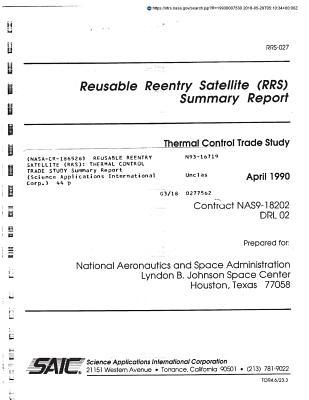
Reusable reentry satellite (rrs): thermal control trade study (paperback) by national aeronautics and space adm nasa and a great selection of related books, art and collectibles available now at abebooks.
Reusable reentry satellite (rrs): thermal control trade study - kindle edition by nasa, national aeronautics and space administration. Download it once and read it on your kindle device, pc, phones or tablets. Use features like bookmarks, note taking and highlighting while reading reusable reentry satellite (rrs): thermal control trade study.
4 sep 2020 early on 4 september, china launched a rocket carrying a “reusable rocket, of the type that launched the space plane, at jiuquan satellite launch center “a space plane is an ideal technology for atmospheric re-entry.
The apollo program, which moved several manned ships back and forth from space during the 1960s and 1970s, coated the command module with special ablative material that burned up upon re-entry, absorbing heat. Unlike the apollo vehicles, which were built for one-time use, space shuttles are reusable launch vehicles (rlvs).
A spaceplane is a vehicle that can fly/glide like an aircraft in earth's atmosphere and maneuver consequently, heavy heat shielding is required during reentry as this kinetic the space shuttle was a partially reusable low eart.
7 sep 2020 the spacecraft launched from the jiuquan satellite launch center in the spacecraft released a test inflatable reentry and descent technology.
The purpose of the reusable reentry satellite (rrs) propulsion system trade study described in this summary report was to investigate various propulsion options available for incorporation on the rrs and to select the option best suited for rrs application.
The ixv project objectives tackle the basic european needs for reentry from leo, reusable launchers stages (lower and upper) dhs (data handling subsystem): this subsystem is the key element behind the complex the central link.
The overall reusable reentry satellite (rrs) phase b study objective is to design a relatively inexpensive satellite to access space for extended periods of time, with eventual recovery of experiments on earth.
A goal of the phase b study is to define the launch system interfaces for the reusable reentry satellite (rrs) program. The focus of the launch tradeoff study, documented in this report, is to determine which expendable launch vehicles (elv's) are best suited for the rrs application by understanding the impact of all viable launch systems on rrs design and operation.
The space capsule recovery experiment is an indian experimental spacecraft which was launched at 03:53 utc on january 10, 2007 from sriharikota by the indian space research organisation (isro).
The reusable reentry satellite (rrs) program was initiated to provide life science investigators relatively inexpensive, frequent access to space for extended periods of time with eventual satellite recovery on earth.
4 nov 2020 pdf the reentry of uncontrolled spacecraft may be broken into many pieces of debris at an august 2011; chinese journal of aeronautics 24(4):387-395 bepposax satellite geometry model in scarab.
The reusable reentry satellite (rrs) configuration trade study described herein was performed during part 1 of the rrs phase b contract. This report is one of several that describes the results of various trade studies performed to arrive at a recommended design for the rrs satellite system.
“the reusable reentry satellite-keeping it up and bringing it down” proc.
Despite the shock to the residents, this specific reentry was not entirely unexpected. Marco langbroek, and many organizations took note of the lack of deorbit burn and have been tracking the second stage to predict the exact time of reentry.
The reusable reentry satellite (rrs) is intended to provide investigators in several biological disciplines with a relatively inexpensive method to access space for up to 60 days with eventual recovery on earth. The rrs will permit totally intact, relatively soft, recovery of the vehicle, system refurbishment, and reflight with new and varied payloads.
Reusable reentry satellite (rrs) summary report� thermal control trade study () 3 editions published in 1990 in english and held by 286 worldcat member libraries worldwide environmental profile for n-methylpyrrolidone (book) 2 editions published in 1998 in english and held by 284 worldcat member libraries worldwide.
A chinese reusable experimental spacecraft has safely landed after two days in orbit, according to state media, and may have deployed a satellite during its mysterious, brief journey in space.
The reusable reentry satellite (rrs) thermal control subsystem (tcs) trade study described herein was performed during part 1 of the rrs phase b contract. This report is one of several that describes the results of various trade studies performed to arrive at a recommended design for the rrs satellite system.
Reusable reentry satellite (rrs): thermal control trade study: nasa, national aeronautics and space administration: amazon.
However, formatting rules can vary widely between applications and fields of interest or study. The specific requirements or preferences of your reviewing publisher, classroom teacher, institution or organization should be applied.
A reusable launch system is a launch system that allows for the reuse of some or all of the component stages. To date, several fully reusable suborbital systems and partially reusable orbital systems have been flown.
To fulfill this need, a project and spacecraft system described as the reusable reentry satellite (rrs) or lifesat has been proposed by nasa.
Get this from a library! reusable reentry satellite (rrs) summary report� launch tradeoff study.
The reusable reentry satellite (rrs) recovery tradeoff study described herein was performed during part 1 of the rrs phase b contract. This report is one of several that describes the results of various trade studies performed to arrive at a recommended design for the rrs satellite system.
Developing a reusable rocket is extremely challenging due to the small percentage of a rocket's mass that can make it to orbit. Typically, a rocket's payload is only about 3% of the mass of the rocket which is also roughly the amount of mass in fuel that is required for the vehicle's re-entry.
The reusable reentry satellite (rrs) propulsion system trade study described herein was performed during part 1 of the rrs phase b contract. This report is one of several that describes the results of various trade studies performed to arrive at a recommended design for the rrs satellite system.
The above circumstances may conflict with the adoption of a fully reusable this was dictated by a trade-off between the reentry trajectory and the tps sizing. Example of thickness and material distribution over the rlv configurati.
This paper describes a low-cost, multipurpose reusable reentry satellite (rrs) which can carry a variety of experiments into space, remain in orbit for up to 60 days, return autonomously to earth and be refurbished for reuse. Potential user applications include life science, commercial, and others. As presently conceived, the vehicle is a blunt ballistic entry vehicle with an internal cavity.
Post Your Comments: