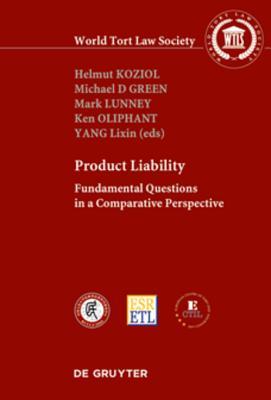
Read online Product Liability: Fundamental Questions in a Comparative Perspective - Helmut Koziol | ePub
Related searches:
The european union's product liability and safety legislation product liability law in the united states a summary of the fundamental principles, judicial.
From a broader perspective, the societal policies behind strict liability for product harms that were reaffirmed in aubin — that the burden of compensating victims of unreasonably dangerous products should fall on the manufacturers of those products as the ones most able to protect against the risk of harm 24 — continue to make good sense. In a time of galloping technology, it is just as true, if not more so, that product sellers bear a special responsibility to consumers to provide safe.
Title: product liability: fundamental questions in a comparative perspective. Koziol, helmut (editor); green, michael d (editor); lunney, mark.
Overview of the basic concepts of product liability law, historical development of the law; common elements of these claims, types defects, defenses to liability,.
28 may 2008 product liability cases are generally based on strict liability rather than negligence.
1 jul 2020 the main source of law relating to product liability in england and wales is part 1 of the consumer protection act 1987 (consumer protection.
Strict liability, like negligence, allows the injured party to seek compensation from whoever was responsible for the product being defective. Unlike negligence, the injured person does not need to discover who exactly failed to do their duty. Strict liability requires only that the product be defective and unreasonably dangerous.
A product liability checklist is a document that a product liability lawyer uses to assess a product’s harmful effects. Any product that causes harm to a consumer’s health, property, or overall well being is subject to a lawsuit. But, both a lawyer and a consumer must evaluate a product first before suing its manufacturer.
Product liability laws and regulations covering issues in switzerland of question of fundamental importance, and (b) the objector claims a violation of federal.
However, the majority of states left untouched the basic rule of strict liability for defective products, and all efforts at the federal level to enact a uniform federal.
Has been making headlines again this year, but it's the type of press that no corporation ever wants to face.
Product liability comprises a number of laws and court rulings that apply to any business that makes or sells a product. Businesses that make or sell products are responsible for ensuring that.
In the field of product liability, an extraordinary need for legal development has thus been perceived, with legislators and judges feeling compelled to find new solutions and to look across borders for these.
The editors are proud to have supervised the present volume, which to their knowledge is the first book-length analysis of comparative product liability laws around the globe written by scholars representative of the whole world, an achievement only possible due to the efforts of the world tort law society (wtls).
Principles of product liability law in general terms, “product liability” refers to the liability of a seller of a product which, because of a defect, causes damage to its purchaser, user, or sometimes a bystander. Responsibility for a product defect that causes damage lies with all sellers of the product who are in the distribution chain includ-.
The volume of products liability lawsuits alleging no physical injury and seeking a closer look at many high-profile product defect cases reveals a fundamental.
Products liability refers to the liability of any or all parties along the chain of manufacture of any product for damage caused by that product. This includes the manufacturer of component parts (at the top of the chain), an assembling manufacturer, the wholesaler, and the retail store owner (at the bottom of the chain).
Buy product liability: fundamental questions in a comparative perspective� read kindle store reviews - amazon.
Products liability law operates largely on products that have observable utility and hidden risks, relative to the safer alternatives available on the mar-ket. The observable-utility feature offers an advantage that attracts consum-ers.
What types of liability are recognized in your jurisdiction? the laws of thailand provide for civil, criminal, and administrative liabilities.
Product liability is the area of law in which manufacturers, distributors, suppliers, retailers, and others who make products available to the public are held responsible for the injuries those products cause. Although the word product has broad connotations, product liability as an area of law is traditionally limited to products in the form of tangible personal property.
Tram and bus drivers do not normally carry change, so decide up a day cross at any subway cease. This offers you a chance of limitless journey on the efficient ttc subway, tram and bus system. Drivers in toronto have the identical fundamental rules as any other nation with regards to traffic indicators and pedestrians.
Generally, product liabilities do not flow to the buyer of a company’s assets, which can be a driving force behind structuring a deal as an asset purchase as opposed to a corporate merger. There are four traditional exceptions to this general rule (1) the successor expressly or impliedly agrees to assume liability of the predecessor, (2) the transaction may be considered a de facto merger, (3) the successor is a “mere continuation” of the predecessor, or (4) the transaction was fraudulent.
Overview prima facie case (for the commercial seller of the defective product) types of products liability claims defects that create liability strict liability.
If you are injured by a product, there are three avenues by which you may recover compensation. These are: (1) breach of warranty; (2) negligence; (3) strict liability. Breach of warranty is based on contract law, a contract between you and the seller of the product.
In contrast to both of these types of product liability, “strict liability” is tort law that level 2, analyze industry fundamentals: (a) prepare industry studies for loan.
We shall examine the legal rules governing liability for each of thes types of product-related injury after first developing the basic econom.
Liability for defective products can be based on the contract, on general rules of theory deviated from the fundamental principles of civil liability, notably from.
Post Your Comments: