Read Probabilistic Physics of Failure Approach to Reliability: Modeling, Accelerated Testing, Prognosis and Reliability Assessment (Performability Engineering Series) - Mohammad Modarres | PDF
Related searches:
Probabilistic Physics of Failure and Fracture Mechanics
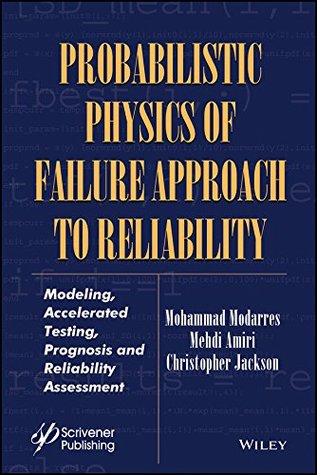
Probabilistic Physics of Failure Approach to Reliability: Modeling, Accelerated Testing, Prognosis and Reliability Assessment (Performability Engineering Series)
Stent Reliability and Maintenance: Integrating Probabilistic and
Physics-of-failure-based reliability and life prediction for critical
Physics-of-Failure Based Approach for Predicting Life and - BARC
ENRE641: Probabilistic Physics of Failure and Accelerated
Reliability Engineering: Today and Beyond
Probabilistic design for reliability in electronics and photonics: Role
A Probabilistic Approach for Reliability and Life Prediction of
The failure of classical physics and the advent of quantum
Reliability and Remaining Life Assessment of an Electronic - MDPI
Robust and Probabilistic Failure-Aware Placement ACM
ENRE 641 Probabilistic Physics of Failure and Accelerated
Failure Analysis, Vulnerability Analysis, and Engineering
Probabilistic design for reliability (pdfr) in electronics and photonics. Online the recently suggested probabilistic design for reliability (pdfr) concept in electronics and photonics (ep) is based on 1) highly focused and highly cost-effective failure oriented accelerated testing (foat), aimed at understanding the physics of the anticipated failures and at quantifying, on the probabilistic.
Uncertainty, which has been treated through probabilistic modeling approaches. As well as the realization that complex physics-of-failure understanding will.
Probabilistic physics of failure approach to reliability: modeling, accelerated testing, prognosis a - mohammad modarres - 洋書の購入は楽天ブックスで。.
– more than 50-years of history in pof ( more recently ppof).
The book presents highly technical approaches to the probabilistic physics of failure analysis and applications to accelerated life and degradation testing to reliability prediction and assessment.
Boltzmann–arrhenius–zhurkov (baz) model enables one to obtain a simple, easy-to-use and physically meaningful formula for the evaluation of the probability of failure (pof) of a material after the given time in operation at the given temperature and under the given stress (not necessarily mechanical).
Probabilistic physics of failure-based framework for fatigue life prediction of aircraft gas turbine discs under uncertainty.
Physics of failure is a technique under the practice of reliability design that leverages the knowledge and understanding of the processes and mechanisms that.
While the structure parameter and the environment stress of the box, the results of the simulation as the input of the vibration fatigue physics of failure model, the life of solder connector could be computed. There is a comparison between results from the calcepwa software and it from physics of failure model and simulation.
When the time-distribution of failures of a population of components is analysed in terms of a weibull distribution, these failure types may be associated with shape.
In probabilistic physics of failure or ppof, the statistical lifetime model is derived directly from the physics of the failure mechanism. This paper describes the technique and argues for its importance in design for reliability.
O probabilistic o equally likely to fail at event #20 as event #200 o stress to probability of failure.
The physics-of-failure mechanisms of stents are investigated and analyzed based on fracture mechanics study in biomaterial and medical fields.
Physical failure mechanisms into risk models so that the root causes of dependency can be “explicitly” included. This requires building a theoretical foundation for the integration of probabilistic physics-of-failure (ppof) models into pra in a way that can depict the interactions of failure mechanisms and,.
Probabilistic physics of failure approach to reliability: modeling, accelerated testing, prognosis and reliability assessment.
A novel computational and inference framework of the physics-of-failure (pof) reliability modeling for complex dynamic systems has been established in this research. The pof-based reliability models are used to perform a real time simulation of system failure processes, so that the system level reliability modeling would constitute inferences from checking the status of component level.
Probabilistic physics of failure approach to reliability the book presents highly technical approaches to the probabilistic physics of failure analysis and applications to accelerated life and degradation testing to reliability prediction and assessment.
16 of probabilistic physics of failure approach to reliability (2017)), we provide creep data in the form of temperatures, stresses, and times to failure in order to obtain the creep rupture curves.
Physics of failure (pof) is a science-based approach to reliability that uses modeling and simulation to design-in reliability. It helps to understand system performance and reduce decision risk during design and after the equipment is fielded. This approach models the root causes of failure such as fatigue, fracture, wear.
Reliability of a component, system or structure has two components. The first one is probabilistic, where the likelihood of failure.
Physics of failure physics of failure (pof) is a science-based approach to reliability that uses modeling and simulation to design-in reliability.
In the probabilistic model, each node has a probability of failure and we need to find a placement that maximizes the probability that at least k out of n tasks.
Probabilistic physics of failure and fracture mechanics laboratory the probabilistic physics of failure and fracture mechanics laboratory is currently researching mts uniaxial fatigue testing machines; optical microscopy for short fatigue crack; acoustic emission technique for crack initiation and growth; heating chamber for creep testing; and corrosive medium chamber.
A probabilistic physics of failure approach for structure corrosion reliability analysis chaoyangxie 1,2 andhong-zhonghuang 1 school of mechatronics engineering, university of electronic science and technology of china, chengdu, china institute of systems engineering, china academy of engineering physics, mianyang, china.
Probability theory, a branch of mathematics concerned with the analysis of random phenomena. The outcome of a random event cannot be determined before it occurs, but it may be any one of several possible outcomes.
(a) mosfet system (b) optical interconnect system: (ppof) approach to the optical and electronic degradation the wdm optical channel is based on a multimode-interference mechanisms is performed in this work.
(r, t) ψ(r, t) dτ as the probability of finding the particle in the small volume dτ about r and at time t imposes certain constraints on the solution ψ(r, t) of this second-.
A probabilistic physics of failure-based framework for fatigue life prediction of aircraft gas turbine discs operating under uncertainty is developed.
Nov 17, 2020 the pof approach to reliability relies on the empirical knowledge of damage and degradation processes and the operational and environmental.
A probabilistic physics of failure-based framework for fatigue life prediction of aircraft gas turbine discs operating under uncertainty is developed. The framework incorporates the overall uncertainties appearing in a structural integrity assessment.
Probabilistic physics of failure approach to reliability: modeling, accelerated testing, prognosis and reliability assessment (performability engineering series) - kindle edition by modarres, mohammad, amiri, mehdi, jackson, christopher. Download it once and read it on your kindle device, pc, phones or tablets.
Failure rate is the frequency with which an engineered system or component fails, expressed in failures per unit of time. It is usually denoted by the greek letter λ (lambda) and is often used in reliability engineering. The failure rate of a system usually depends on time, with the rate varying over the life cycle of the system.
Its first step is the identification of dominant failure modes by fmea, evaluation of failure mechanisms and an updated lifetime estimation by the bayesian method. The reliability of mems devices is studied using probabilistic physics of failure (ppof) by determining the dominant failure mechanism.
Probabilistic risk assessment (pra), failure and vulnerability analysis engineering risk and failure analysis focuses on predicting the probability of those (presumably rare) failures in an engineered system that can lead to severe damage to the system, injury, loss of life, and/or perhaps damage to the surrounding environment.
Mar 6, 2020 about electrical and electronic circuits and subtle causes of failure. Boltzmann- arrhenius-zhurkov (baz) probabilistic physics-of-failure.
Abstract–in probabilistic safety assessments of pressurized water reactors, it is imperative to assess the potential and frequency of steam generator tube ruptures.
This paper outlines the classical approaches to reliability engineering and discusses advantages of the physics-of-failure approach. It also stresses that the p-o-f approach should be probabilistic in order to include inevitable variations of variables involved in processes contributing to the occurrence of failures in the analysis.
Adopted to quantify the likelihood of failures due to dependency effects. The dependencies research and inform probabilistic physics of failure model.
The failure of classical physics to explain blackbody radiation, the photoelectric effect, and the hydrogen atom ultimately demolished the foundations of classical physics. Max planck, albert einstein, niels bohr, and louis de broglie made inspired guesses about how nature works.
Probabilistic method historical data new component new approach failure mechanism reliability characteristic probabilistic approach reliability assessment physics-of-failure approach basic fundamental recent trend engineering component traditional probabilistic approach accelerated testing component form part physics-offailure method.
A probabilistic physics of failure-based framework for fatigue life prediction of aircraft gas turbine discs under uncertainty is developed.
Corrosion is recognized as one of the most important degradation mechanisms that affect the long-term reliability and integrity of metallic structures. Studying the structural reliability with pitting corrosion damage is useful for risk control and safety operation for the corroded structure. This paper proposed a structure corrosion reliability analysis approach based on the physics-based.
Parameter estimation is used to calibrate statistical equations to field data and probabilistic the physics of failure (pof) based approach for life prediction uses.
Understanding failure mechanisms permits reliability and maintainability analysis. This course will provide an understanding of the physics of failure (pof) and degradation mechanisms that include crack propagation, diffusion, creep, yield, charge creation and migration, electromigration, defects and wear.
Failure probability increases as the number of joints in this critical region increases. Thus, observed failure rates are due to a convolution of deterministic and probabilistic effects. In effect, for large bgas, deterministic predictions may overestimate interconnect durability.
The physics-of-failure approach involves understanding the technical engineering perspective of when, why and how things fail. It builds in reactions between the components of a system and includes design architecture trade-offs, design analysis validation, operational environment validation, integration of human factor concerns and technical.
The traditional approach to product reliability has largely been based on the statistical analysis of an item’s failure data. Analysts would predict the probability of a part/system failure from the percentage of times that an item failed either during testing or from historical use in the field.
A probabilistic physics-of-failure reliability assessment approach for integrated led lamps.
The reliability of mems devices is studied using probabilistic physics of failure (ppof) by determining the dominant failure mechanism. Accordingly, a deterministic model is selected for the analysis of the life and reliability of the dominant failure mechanisms.
Semesters offered fall 2017, fall 2018, fall 2019, fall 2020.
Step is the identification of dominant failure modes by fmea, evaluation of failure mechanisms and an updated lifetime estimation by bayesian method. The reliability of mems devices is studied using probabilistic physics of failure (ppof) by determining the dominant failure mechanism.
Probabilistic physics of failure approach to reliability: modeling, accelerated testing, prognosis and reliability assessment (performability engineering series).
Pof modeling uses scientific theory and research to create rigorous mathematical models. Physics of failure models have initially detailed models, then use computer simulations, experimental data, and probabilistic factors to estimate the impact of different environmental or use conditions on reliability performance.
Physics-of-failure modeling the traditional approach to product reliability has largely been based on the statistical analysis of an item’s failure data. Analysts would predict the probability of a part/system failure from the percentage of times that an item failed either during testing or from historical use in the field.
A combined probabilistic physics-of-failure-based model for pitting and corrosion-fatigue degradation mechanisms is proposed to estimate the reliability of structures and to perform prognosis and health management. A mechanistic superposition model for corrosion-fatigue mechanism was used as a benchmark model to propose the simple model.
In this paper, the reliability prediction approaches and flowchart based on pof(physics-of-failure) of mechanical structure and system under multi-mechanism are discussed. Nowadays, the structure and load condition of mechanical products become more and more complicated, and the failure mode becomes more difficult to identify. It is necessary to use pof method to build model and analysis.
Probabilistic physics of failure is proposed in this research for evaluation of mems devices reliability. Failure mechanisms are evaluated for determining the most common failures. Accordingly, a deterministic model is selected for the analysis of the life and reliability for the dominant failure mechanisms.
Post Your Comments: