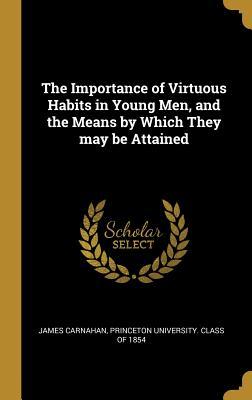
Download The Importance of Virtuous Habits in Young Men, and the Means by Which They May Be Attained - James Carnahan | PDF
Related searches:
Explain the role of practice and habit in forming virtues. Aristotle
The Importance of Virtuous Habits in Young Men, and the Means by Which They May Be Attained
The Importance of Virtuous Habits in Young Men, and the means
The Importance Of Virtuous Habits In Young Men, And The Means
Understanding and Living the Virtues Diocese of La Crosse
Integrity and virtue: The forming of good character - NCBI - NIH
The Cognitive Implications of Aristotelian Habituation and Intrinsic
The Moral Philosophy of Bitcoin. Virtuous Habits and the
Living The Virtuous Life. Intermingling Religious and by breven
Between Instinct and Habit - enlightenment
The Habit Model of Moral Development Psychology Today
Virtues Are Good Habits - The Spiritual Life
Ethics and Virtue - Markkula Center for Applied Ethics
7 Reasons Why It Is Important to Form Good Habits and How to
Summary and Analysis Book II: Chapter I - Moral Virtue - CliffsNotes
Virtue Development and Role of Character in Decision Making
The importance of virtue ethics in the IRB - Marilyn C Morris, Jason Z
From Virtue Signaling to Virtue Living: Becoming the Virtuous
The Characteristics Of Aristotle's Virtue In Society ipl.org
Aristotle: Nicomachean Ethics Book Two Summary and Analysis
Virtue and Character Encyclopedia.com
The Three Primary Virtues - Brian Tracy
Virtue Ethics: Morality and Character - Learn Religions
Growth in Infused Virtue in the Work of Thomas Aquinas
17: Habits and Virtues: Does It Matter if a Leader Kicks a Dog
Aristotle on habit and moral character formation Request PDF
3 Things You Should Know About VIRTUE - The Habit Factor
The Importance Of Virtue Ethics In Engineering - 1182 Words Cram
The Virtuous Person as Norm in Aristotle's Moral Theory
The Place of Virtue in a Meaningful Life – The Virtue Blog
Courage and Compassion: Virtues in Caring for So-Called “Difficult
Intellectual and Character Virtues - Montrose School
The Importance of Teaching Our Children Virtuous Behavior
Ethics - The Virtuous Nurse
Why the Military needs Confucian Virtues
Socrates And Aristotle On Virtues - UKEssays.com
(PDF) The Role of Character in Ethical Decision-Making
The Habits of Aristotle
The Virtues of Character According to Aristotle Literature
The Biology of Positive Habits Harvard Graduate School of
Importance of Developing Virtues and Character in Higher
The Meaning of Virtue in St. Thomas Aquinas Christendom Media
The Virtuous Leader - Police Chief Magazine
Do the right thing: inside the business of 'virtuous
Building the Habit of Excellence
Aquinas' Account of the Virtues
Aristotle and Justice - Philosophy
Aristotle distinguishes two kinds of virtue (1103a1–10): those that pertain to the part of the soul that engages in reasoning (virtues of mind or intellect), and those that pertain to the part of the soul that cannot itself reason but is nonetheless capable of following reason (ethical virtues, virtues of character).
They consciously or unconsciously notice how leaders act in formal, informal, public and private settings and they use this information to draw inferences about leaders’ virtues, vices, habits, and future behavior.
So virtue is a purposive disposition, lying in a mean that is relative to us and pleasure and pain is one of the most important habits to develop for moral virtue.
Virtue is defined as a habit or quality that allows individuals to succeed at their purpose. Socrates and aristotle are referenced considerably about virtuosity.
The necessity of forming good habits in order to become virtuous leads aristotle to consider law and education as crucial means of making the citizens virtuous. While the details regarding law-making are reserved for the politics, in nicomachean ethics aristotle provides an explanation of why good laws are necessary to form virtuous citizens.
Yet in what sense the virtues are habits remains a complex question that involves the question of how the virtues are individuated. For aristotle some of the virtues are qualities that qualify the emotions, but not all the virtues are like courage and temperance in that respect.
It is commonly thought that virtues, according to aristotle, are habits and that the good life is a life of mindless routine�.
Adam smith, in his important book the theory of moral sentiments, wrote that excellent people have three primary virtues: prudence, justice, and benevolence,.
A virtuous habit of action is always an intermediate state between the or mentoring (moberg, 2008). Phronesis is also related not only to the importance of character in ethical rational.
Habits set a foundation for life since habits become you, the habits that you choose to follow set the tone for your entire life. If you have a habit of greeting your children with joy, you will become a joyful person. If you have a habit of eating a vegetable with every meal, you will become a healthy person.
The habits, actions, and emotional responses of the person of good character all are united and directed toward the moral and the good.
A common theme among virtue ethicists is stressing the importance of cultivating ethical values in order to increase human happiness.
Sep 19, 2018 virtue ethics focuses on the development of sound moral character rather than moral rules.
While ethical virtues such as bravery, generosity and good temper are important habitual dispositions essential to living a virtuous life, it is justice that aristotle acknowledges as the most complete virtue because it incorporates all of the other ones. By neglecting any given virtue, the person also breaches justice as well.
The power of habit comes in its susceptibility to practice and development, like all other sports, arts or skills. This means that we can grow in moral excellence, and therefore have every reason to foster an aristotelian growth mindset. Moral virtues become the qualities of a person through active exercise of them.
Aristotle (384–322 bc) was a scholar in disciplines such as ethics, metaphysics, biology and botany, among others. It is fitting, therefore, that his moral philosophy is based around assessing the broad characters of human beings rather than assessing singular acts in isolation.
The first and most important habit you need to develop is self-discipline. This means the ability to be in control of yourself, your habits, and your life.
Jan 3, 2014 in the nicomachean ethics, aristotle maintains that the virtues are formed by repetition as are other habits (see book ii, chapters 1-5).
Virtue ethics (ve): an action is right iff it is what the virtuous person would do in similar circumstances.
Dec 19, 2016 the shopper covets the expensive item and worries vaguely about the credit card bill.
For aquinas, the habitual formation of desire toward the good is of nothing less than ultimate importance; it is, he says.
Remember virtues are good habits developed out of love for others. When you begin growing in one virtue, you’ll end up growing in many of them simultaneously! orderliness: achieving our goals by doing the things we should do, when we should do them, and how we should do them.
The four classic cardinal virtues in christianity are temperance, prudence, courage (or fortitude), and justice.
Education and living the virtuous life are key themes for aristotle, but is one more important than the other? aristotle does not see the learning of good habits (virtues) as training that is above this education, which is why he concludes with this point about good character when he says that “it is evident that the education of [good.
Moral virtue, on the other hand, comes about as the result of habit and practice. This shows that the moral virtues are not implanted in man by nature, for nothing.
The four cardinal virtues are prudence, justice, fortitude, and temperance. There are a number of ways in which we acquire human virtues.
The virtuous man must feel pleasure in virtuous action and pain in vicious action, such that his passions naturally draw him towards virtue and away from vice.
Dec 21, 2017 historically, virtue theory is one of the oldest moral theories in western philosophy, having its roots in ancient greek civilization.
Aristotle, virtues are also the most important habits for people looking to achieve eudaimonia. The concept of eudaimonia, which is central to aristotelian philosophy, is often translated into.
Dec 2, 2020 for aristotle, inculcating virtues through habitual action could develop a moral character.
Develop positive, virtuous habits for himself and is now on a mission to share what he's learned with the world through his writing and speaking. On today's show, james and i go on a deep dive into habit formation. We talked about the difference between identity-based habits and outcome-based habits.
Nov 30, 2015 in the second book of his nicomachean ethics, aristotle begins to discuss the nature of virtues and argues that virtues of character, such as justice.
Jan 4, 2017 the most significant contribution of virtue ethics is the role of discriminative intelligence (practical wisdom) in decision making.
Nov 14, 2014 a role model or exemplar that one can imitate, cultivating morally appropriate habits that become moral virtues over time.
Free essay: virtue ethics in engineering virtues are desirable habits or tendencies in action, commitment, motive, attitude, and emotion, and virtue ethics.
Socrates stresses that virtue was the most important possession and that life must be lived in pursuit of good (sherman, 1997). While both of the philosophers believed in the benefit of having virtues, it is socrates who stresses more than aristotle the importance of the virtues.
Virtues do the same for the human character: they continually straighten us out so that eventually we can, through habit, become virtuous. Strengths of virtue ethics - examines the moral agent unlike many other ethical theories.
By contrast, according to virtue-based theories, (1) greater importance is placed on developing good character traits than on acting in accordance with moral rules; (2) good actions are those that flow from our virtuous character traits; and (3) morality is a matter of being a good person, which involves having virtuous character traits.
Just as the tv can be used in a positive way to enrich and teach important values to our children, the classroom is an excellent place to create positive change. Imagine teaching virtuous behavior, such as kindness, compassion, and cooperation, alongside, mathematics, social studies, and science.
Each of these virtues, rather than being an inborn personal trait, are habits and states of mind that can be consciously cultivated using a systematic approach. In this post i can only cover a brief introduction of each, and suggest some further reading.
Needs to be guided by the good, which is an objective pattern that our minds can grasp. • there are four main virtues: wisdom, self-control (tem- perance), courage.
Virtues are habitual and excellent ways of being and acting in the world. To become virtuous we should acquire the right sort of habits and desires in childhood� but more generally to become more.
Feb 22, 2018 virtue is defined as a habit or quality that allows individuals to succeed at their purpose.
Nov 20, 2017 it can seem as though virtue and meaning have very little to do with each other. Women and their sexual habits, where 'virtue' was a matter of chastity.
The precise nature of this relationship between virtue and habit is principally explicated through a partial analogy between virtue and the arts. In book ii, chapter 1, aristotle presents his analogy of virtue to the arts largely in order to argue for virtues as sets of skills gradually developed over time through practice.
Virtues are habitual and excellent ways of being and acting in the world. To become virtuous we should acquire the right sort of habits and desires in childhood; but more generally to become more.
Living virtuous lives helps us to live in true peace and joy, because we “not only perform good acts but give the best of ourselves” (catechism of the catholic church, paragraph 1803) therefore, we should all want to pursue this goal. However, developing the virtues is not something that we simply accomplish through our own will power.
Therefore, virtues of character are subordinate to virtues of thought and serve as the means to achieve happiness. Then, aristotle discusses how virtues of character are acquired. People attain the virtues of character by practicing and becoming habituated to them.
Virtue also is important because, unlike some kinds of rule-based ethics, virtue involves the whole person.
The virtuous agent acts as a role model and the student of virtue emulates his or her example. Initially this is a process of habituating oneself in right action. Aristotle advises us to perform just acts because this way we become just. The student of virtue must develop the right habits, so that he tends to perform virtuous acts.
What, if anything, can medical ethics offer to assist in the care of the “difficult” patient? we begin with a discussion of virtue theory and its application to medical.
Jun 17, 2016 virtue ethics also strongly emphasizes that individuals can be trained in the virtues so that they develop excellent habits of mind.
For aristotle, habits are the primary determiner of character.
A virtue is a moral habit which generally results in the gaining or maintaining of your values.
◦moral virtues can only be acquired through practice and experience. They involve acquiring habits of character and have to do with the appropriate management.
Aquinas’ answer to this question starts from the following principle: for any two virtues, the more excellent virtue has the more excellent object. 46 hence, of all of the intellectual virtues, wisdom is the most important because its object–the first and supreme cause 47–is the most excellent object of knowledge.
Jan 15, 2003 in this way, the greek philosophers claim, virtuous activity completes or perfects human life.
A virtue is a moral habit which generally results in the gaining or maintaining of your values. Your values are based on your moral standard which should be your own life. Virtues are pre-thought out methods for achieving your values. This means that with rational virtues, acting virtuous leads to a happy and successful life.
Some studies have investigated the role of virtues in preventing undesirable life outcomes and buffering against mental health disorders.
Animals (ne book i, ch 5), and that a virtuous community was important for at least two reasons. First, virtue is largely a product of the habits inculcated in us through education (ne book 1 ch3). Moreover, aristotle even believed a person could not lead a flourishing, fulfilling life if they didn’t have the good.
Sep 15, 2019 then the paper examines the role of virtues, habits, and dispositional keywords: leadership; leadership ethics; virtue; habit attribution;.
It defines good actions as ones that display virtuous character, like courage, loyalty, or wisdom. Bad actions display the opposite, such as cowardice, treachery, and ignorance. For aristotle, ethics was a key element of human flourishing because it taught people how to differentiate between virtues and vices.
—virtues may be divided into intellectual, moral, and theological. —intellectual virtue may be defined as a habit perfecting the intellect to elicit with readiness acts that are good in reference to their proper object, namely, truth.
Importance in virtue and the good virtues are thus habits of action or disposition to act in particular ways.
Therefore, a virtuous character can be cultivated, and the life of a virtuous human being is a life that is well sustained life, and a well sustained life in accordance to (hexis) moral virtues, are established through proper habits (karuzis, 2015). Whilst moral virtues determine a yearning for eudemonia, those who may not experience ‘proper.
Virtue ethics is a philosophy developed by aristotle and other ancient greeks. It is the quest to understand and live a life of moral character. This character-based approach to morality assumes that we acquire virtue through practice. By practicing being honest, brave, just, generous, and so on, a person develops an honorable and moral character.
A virtue is the habit of doing good, making it easy and delightful. A virtuous person is free! the christian virtues give us freedom from being overpowered by temptations and our vices. Everyone is born with a capacity for virtue, but we need education and practice to attain the freedom, harmony, and balance of the virtuous, excellent human being.
That is, once they are acquired, they become characteristic of a person. For example, a person who has developed the virtue of generosity is often referred to as a generous person because he or she tends to be generous in all circumstances.
The word “habit” in greek, is ethos, from which english gets the words “ethics” and “ethical. ” 2 the latin word for “custom” or “habit” is mos, from which english gets the words “moral,” “morals,” and “morality. ” 3 thus, a virtuous person is at once ethical and moral, and there is no ethics or morals without.
The importance of virtuous habits in young men, and the means by which they may be attained [carnahan, james, princeton university.
In theory, there may be no better “cause” than the development of one's virtue.
Psychology, i situate these unique habits among the important elements of grace, gifts, beatitudes, fruits, and even the acquired virtues.
The importance of virtuous habits in young men, and the means by which they may be attained [facsimile] [carnahan, james, 1775-1859] on amazon. The importance of virtuous habits in young men, and the means by which they may be attained [facsimile].
Post Your Comments: